Alkaline Herbs and Spices
Acid-Alkaline Spices and Herbs Food Chart is a list of acid or alkaline values for common herbs and spices. I explain the values for this food list, and related lists, in my Basic Acid Alkaline Food List Introduction.
Remember: these tables help you make better food choices. But, the only way to confirm they are having the desired effect, is by measuring your urine pH. Fortunately, this is a simple process, using widely available pH test strips or meters.
Acid-Alkaline Spices and Herbs Introduction
As a food lover, spices and herbs are important to me. As they elevate most meals with added flavor. Also, they’re a good source of beneficial nutrients. Yet from a nutritionists point of view they are losing importance. Because spices do not form a significant enough part of modern dietary patterns to justify their own group. And herbs are included in vegetable food groups.
So this has presented me with some challenges as I move food lists to ALKAscore. But I will soon be adding an `Uncategorized` group to the current groups defined in Dietary Guidance fo Americans (DGA). Similar to my WWEIA Acid-Alkaline Uncategorized Foods List.
Here at Foodary, I’ll continue to investigate how diseases and wellbeing are affected by herbs, spices, and seasonings. Because, despite losing this category as a modern food group, there is lots of science for me to research and summarize for you.
However, the relatively low intake levels of culinary herbs and spices do not necessarily mean that they are of little value as their high polyphenol content, and thus ultimately the potential biological impact of this content, cannot be ignored. [1]
Individual Herbs, Spices, and Seasonings Science
As well as looking at herbs, spices, and seasonings as a group, I will also investigate studies on specific plants. Because there is significant interest in anise, balsamic vinegar, black pepper, capers, cardamom, cayenne pepper, chili, cillantro (coriander), cinnamon (dalchini), cloves, cumin, curry powder, dill, fennel, fenugreek, garlic, ginger, horseradish, mint, mustard, nutmeg, onion powder, oregano, paprika, parsley, peppermint, rosemary, saffron, sage, sumac, tajin, thyme, turmeric, and vanilla.
Acid-Alkaline Spices and Herbs Food List
I’ve retired the old format for Acid-Alkaline Spices and Herbs Food List. But the original list is available as a free Alkaline Spices, Herbs, and Seasonings Spreadsheet. Where I’ve added additional columns to take advantage of the spreadsheets in-built sorting functionality. So it’s easy for you to change the alphabetic default. As you look for highest and lowest alkalinity by weight or by calories.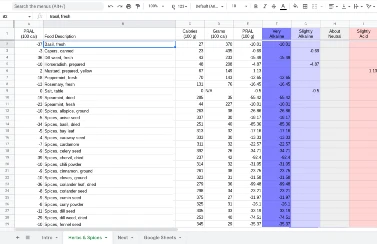
Note that this spreadsheet is also available to Foodary Nexus Newsletter subscribers. So rather than download each spreadsheet individually, consider subscribing for easier access:
Subscribe to Free Foodary Nexus
Subscription is free, and your email address is safe - I will never share it with anyone else. I use Gumroad to provide this service, as described at the Foodary Nexus Newsletter Service.
One benefit from my PRAL spreadsheets upgrade is that it’s now easy to see the most acidic and the most alkaline herbs and spices. So here are some significant highlights for you…
Most Acidic Herbs and Spices
As they are essentially vegetables, no herbs are acid-forming. But spices are also from plants. So there are only 3 spices with a positive acid load. And the PRAL value is so low that it is unlikely to affect your daily PRAL target.
The most acidic spice is yellow mustard seed, with a PRAL value per 100 calories of 3. But that 100 calories is almost an ounce of mustard seeds. So typical consumption is insignificant. Similarly, when the seed is ground and prepared as a mustard condiment, its PRAL value per 100 calories is 2.
That leaves white pepper with a PRAL value per 100 calories of 1. Which again is insignificant. But interesting when compared with the alkaline values for black, red, and cayenne pepper. Because their negative acid load gives a PRAL value per 100 calories of -10.
Most Alkaline Herbs and Spices
These are the herbs and spices with the lowest acid load. Where the number before each food is the PRAL score per 100 calories:
- -39 ┈ Spices, chervil, dried
- -37 ┈ Basil, fresh
- -36 ┈ Dill weed, fresh
- -36 ┈ Spices, coriander leaf, dried
- -34 ┈ Spices, basil, dried
- -30 ┈ Spices, parsley, dried
- -29 ┈ Spices, dill weed, dried
- -23 ┈ Spearmint, fresh
- -22 ┈ Spices, tarragon, dried
- -19 ┈ Spearmint, dried
- -19 ┈ Spices, savory, ground
- -18 ┈ Spices, marjoram, dried
- -18 ┈ Peppermint, fresh
- -16 ┈ Spices, oregano, dried
- -15 ┈ Thyme, fresh
- -15 ┈ Spices, sage, ground
- -13 ┈ Spices, turmeric, ground
- -13 ┈ Spices, thyme, dried
- -13 ┈ Spices, paprika
- -13 ┈ Rosemary, fresh
Your Alkaline Spices and Herbs
Please note that I am reorganizing the food charts to match the latest USDA database categories. So this spice categories chart will be replaced. Please see PRAL Food Category List for the latest categories.
As well as improving this chart, I want to help you make healthier food choices. So, what are your experiences with alkaline spices and herbs? I’d love to discuss your questions, experiences, and opinions about all aspects of healthy eating.
Alkaline Spices and Herbs Comments
I’ve moved commenting into the Foodary Nexus. Where you can share your questions, experiences, and opinions about alkaline herbs and spices. For more information, I recommend that you subscribe to my free newsletter.
If you are asking a question, it is best to:
- Search for that question in the Foodary Search Engine first.
- Choose the most relevant result.
- Refer to that result as you ask your question.
Old Alkaline Spices and Herbs Comments
Foodary visitor responses include:
Alkaline Herbs and Spices for Vegetables
Roz told me she found the Acid-Alkaline Spices and Herbs Food Chart very interesting. Also, she added that she cooks a lot of vegetables. So I agreed that spices and herbs are a great addition to vegetables. Because they make it easy to stick to an alkaline diet. With a high proportion of alkalizing plant-based foods.
I asked Roz if she had any good spicy veg recipes to share. Because I find a lot of recipes from cookbooks and cooking websites are hard to follow. But I love recipes from friends that have been tried and tested. So if you have any please send them in the Feedback Form below.
Is Turmeric Alkaline or Acidic?
Billy commented:
Some, like Dr Sebi, say that turmeric is not Alkaline. Also, curry. Yeah, I see them on your list. Please explain
To which I replied:
I never heard of Sebi until you mentioned him. But it only took me a minute to find out he wasn’t a doctor. Neither am I, but I don’t make false claims.
For all the wrong reasons, he advocates a plant-based diet. Personally, I eat mostly plants. But I avoid the risks of going totally veggie by eating a vaguely Mediterranean style eating pattern. With fish around twice a week and meet around twice a month. Because that’s the easiest way for me to ensure I get essential nutrients without supplements. Also, I have to ask what you mean by curry as it has a lot of different interpretations.
I finished by asking for more information from Billy before answering specifically about turmeric. Because it clearly is alkaline. But I struggle to refute claims without a specific reference to what I’m explaining.
As a general note, I realize there is a lot of confusion about measuring alkaline foods. Because there is a lot of misinformation out there. So if you want me to clarify someone else’s opinion, please include a link or a quote, so I can answer properly. All you need to do is paste the link into the feedback form when you add your comments. But before you send me your feedback, please subscribe to this website:
Subscribe to Free Foodary Nexus
Subscription is free, and your email address is safe - I will never share it with anyone else. I use Gumroad to provide this service, as described at the Foodary Nexus Newsletter Service.
Leave Alkaline Spices and Herbs to read more charts at Basic Acid Alkaline Food Chart Introduction.
Alkaline Spices and Herbs Related Topics
Please remember: to find more related pages that are relevant to you, use the search box near the top of every page.
Common Terms: cinnamon, combination, Most Helpful Foodary Articles, reflux, seeds, vegetable
Other posts that include these terms:
- Alkaline Grains List
- Acid-Alkaline Dairy and Egg Products Food List
- Alkaline Drinks List
- Acid-Alkaline Beef List
- Acid-Alkaline Legumes and Legume Products Food Chart
- Alkaline Nuts and Seeds List
- Alkaline Fish List
- Alkaline Fruit Juice and Fruits List
- Acid-Alkaline Poultry Products Food List
- Alkaline Meats List
- Acid-Alkaline Vegetables Food List
- Acid-Alkaline Soups, Sauces, and Gravies Food List
Alkaline Spices and Herbs References
- Opara, E.I. and Chohan, M., 2014. Culinary herbs and spices: their bioactive properties, the contribution of polyphenols and the challenges in deducing their true health benefits. International journal of molecular sciences, 15(10), pp.19183-19202.